Our Bridge Lab Project: Engineering Equity in STEM
*Updated Sept. 12––see below for latest revisions.
Mission
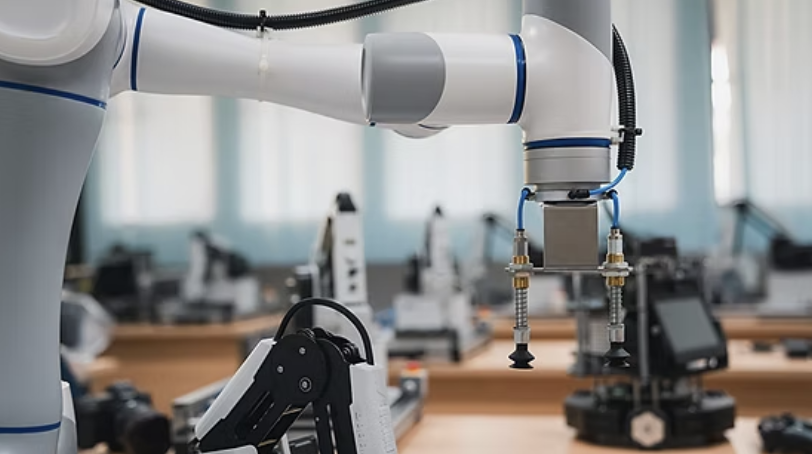
Bridge Lab (formerly Robolink) is a youth-led project tackling educational inequality in STEM. By creating low-cost robotic arm kits and open-source STEM learning modules, it enables under-resourced schools to teach robotics and engineering at a fraction of the usual cost.
- Traditional robot-arm-building kits: $7,000+
- Bridge Lab's model: $400 (94% cost reduction)
Bridge Lab allows us to make robotics education accessible to every student regardless of background.
Leadership + Collaboration
The project’s development and coordination phase consisted of:
- March 2025: Recruit and direct a multidisciplinary team of high school students in programming, design, and hardware engineering.
- March – August 2025: Collaborate with STEM students to prototype and refine the robotic arm using 3D printing and Arduino programming.
- August – September 2025: Oversee open-source curriculum design, aligning lessons with national STEM standards in pilot regions.
Bridge-lab is being developed as a student-led R&D initiative bringing together STEM and humanities students to design solutions reducing educational inequality.
Impact + Implementation
Bridge Lab's first pilot programs will launch in Ho Chi Minh City, Vietnam and Cavite, the Philippines, where access to robotics education is scarce despite strong student interest.
Pilot Targets (Mar 2026 – Nov 2026):
- 2 countries, 10+ partner schools
- 50 robotic arm kits deployed
- 20 teachers trained
- 1,000+ students reached
- ≥ 75% of students reporting increased STEM interest
The project measures impact through learning outcomes and cost-effectiveness.
Innovation
Bridge Lab's model merges the following:
- 3D printing → low-cost, repairable hardware
- Arduino microcontrollers → accessible programming
- Open-source design → global scalability
- Modular learning → flexible use in classrooms and clubs
Each element was tested through iterative student-led design cycles to ensure performance and affordability. We worked to align this process with the best-practice criteria for educational robotics: affordability, portability, and untethered operation (NASA Technical Reports, 2023).
Why It Matters
Globally, access to quality STEM education remains uneven:
- Women make up only 35% of STEM graduates (UNESCO, 2023).
- In the U.S., racial disparities in STEM appear as early as kindergarten (Education Week, 2023).
- Educational robotics systems remain financially inaccessible, with entry-level kits often exceeding $1,000 (NASA Technical Reports, 2023).
Bridge Lab's cost innovation directly addresses these barriers, thus engineering access where inequity once existed.
Looking Forward
Over the next three years, Bridge Lab aims to:
- Reach 10,000+ students across Southeast Asia
- Train 200+ teachers in low-cost robotics instruction
- Establish a global open-source repository for schools to build their own kits locally
For further information or collaboration inquiries, please contact us at growthlinkofficial@gmail.com! You can also follow our updates and research by subscribing to this blog.
*Update (September 12, 2025): Due to technical difficulties in hardware integration and sensor calibration, we experienced delays in prototype development. With our new schedule, we will complete and implement the final product by Spring 2026, as outlined in our Projects in Preparation post. Our new schedule consists of:
- March 2025: Recruit and direct a multidisciplinary team of high school students in programming, design, and hardware engineering.
- March 2025 – Jan 2026: Collaborate with STEM students to prototype and refine the robotic arm using 3D printing and Arduino programming.
- Jan – Feb 2026: Oversee open-source curriculum design, aligning lessons with national STEM standards in pilot regions.
Below is a sample of our current Bill of Materials:
| Category | Part Number | Description | Spec | Qty | Unit cost | Extended cost | Notes |
|---|---|---|---|---|---|---|---|
| Electronics | ARD-NANO-328P | Microcontroller board (Arduino Nano, ATmega328P) + USB cable | 5 V / 16 MHz | 1 | 6.00 | 6.00 | Common clones OK; classroom-proven |
| PCA9685-16CH | 16-ch I²C PWM servo driver | I²C, 12-bit PWM | 1 | 4.00 | 4.00 | Allows >8 servos without timing jitter | |
| LM2596-5A | DC-DC buck converter (adjustable) | 5 A max (derate 3 A cont.) | 2 | 2.50 | 5.00 | One for logic/IMU @ 5 V, one for servos @ 6 V | |
| PSU-12V-5A | AC adapter power supply | 12 V 5 A (2.1 mm barrel) | 1 | 12.00 | 12.00 | Wall-mount for classroom safety | |
| SW-ROCKER-DC | Panel rocker switch + barrel jack | 2-pin 10 A | 1 | 2.00 | 2.00 | Inline power control | |
| FUSE-5A-INLINE | Inline fuse holder + 5 A fuse | 5×20 mm | 1 | 1.00 | 1.00 | Over-current protection | |
| DUP-20CM-40 | Dupont jumper wires (M/F, 20 cm) | pack 40 pcs | 1 | 3.00 | 3.00 | Signal wiring | |
| SERVO-EXT-30CM | Servo extension leads | 10 pcs 3-pin 30 cm | 1 | 5.00 | 5.00 | Clean routing to joints | |
| IMU-MPU6050 | 6-DoF IMU module | MPU-6050 | 1 | 3.00 | 3.00 | Optional orientation sensor | |
| LIMSW-LEVER | Micro limit switches (roller lever) | pack 3 pcs | 1 | 2.00 | 2.00 | Homing / end-stop | |
| GROM-FER-PACK | Cable grommets/ferrules/glands | assorted | 1 | 2.00 | 2.00 | Strain relief & safety | |
| Actuation | SERVO-DS3225 | High-torque servo, metal gear | 25 kg·cm @ 6.8 V | 4 | 18.00 | 72.00 | Base + shoulder × 2 + elbow |
| SERVO-MG996R | Standard servo, metal gear | ~11 kg·cm @ 6 V | 3 | 9.00 | 27.00 | Wrist pitch/roll + spare axis | |
| SERVO-SG90 | Micro servo for gripper | 1.8 kg·cm @ 5 V | 1 | 2.00 | 2.00 | Jaw open/close | |
| Mechanical | PRINT-PLA-800G | 3D printed structural parts | ~800 g PLA/PETG | 1 | 16.00 | 16.00 | DXF/STL provided (~30–40 h print) |
| BEAR-608ZZ | Ball bearing (8×22×7 mm) | 608ZZ | 4 | 0.50 | 2.00 | Base/shoulder pivots | |
| BEAR-625ZZ | Ball bearing (5×16×5 mm) | 625ZZ | 6 | 0.60 | 3.60 | Elbow/wrist pivots | |
| BEAR-F686ZZ | Flanged bearing (6×13×5 mm) | F686ZZ | 4 | 0.80 | 3.20 | Guided shafts/idlers | |
| INS-M3-HEATSET | Heat-set threaded inserts | brass M3 × 100 pcs | 1 | 5.00 | 5.00 | Durable threads in prints | |
| HW-M2M3-KIT | Screw & nut assortment | M2/M3 × 400 pcs | 1 | 9.00 | 9.00 | General fasteners | |
| STANDOFF-M3 | Standoffs assortment | M3 nylon/brass mix | 1 | 4.00 | 4.00 | Electronics mounting | |
| HORN-25T-AL | Aluminum servo horns | 25 T spline metal | 4 | 2.00 | 8.00 | For DS3225 servos | |
| LS-100MM | Turntable bearing (lazy susan) | Ø 100 mm | 1 | 7.00 | 7.00 | Base rotation support | |
| CABLE-SPIRAL | Cable spiral wrap | ~2 m | 1 | 2.00 | 2.00 | Cable management | |
| RUBBER-FEET | Anti-slip rubber feet | 4 pcs | 1 | 2.00 | 2.00 | Bench protection | |
| Safety / Misc | ESTOP-22MM | Emergency stop button (latching) | 22 mm panel | 1 | 6.00 | 6.00 | Power kill switch |
| HEATSHRINK-PACK | Heat-shrink tubing assortment | 3:1 sizes | 1 | 3.00 | 3.00 | Insulation & strain relief | |
| Spares / Overhead | SPARE-MG996R | Spare standard servo | MG996R | 1 | 9.00 | 9.00 | Field replacement |
| PACKING-QC | Packaging + labels + QC time | per kit | 1 | 8.00 | 8.00 | Consumables & time | |
| SHIPPING-LOCAL | Local shipping / handling | per kit | 1 | 10.00 | 10.00 | Delivery to schools | |
| CONTINGENCY-5PCT | Contingency reserve | ~5 % parts | 1 | 15.00 | 15.00 | Breakage / variability |
TOTAL: $258.80
Prototype validation and field testing are underway; final open-source release and pilot data are expected by Spring 2026.